The Serviceberry
At your speed≈ 2½ hrs
Pages113
Audiobook≈ 4 hrs
113 pages works out to roughly 34,000 words. At an average 250 words a minute that is 2½ hrs — a day's reading.
Readers on Hardcover rate it 4.13 out of 5, from 140 ratings.
How long does it take to read The Serviceberry?
The Serviceberry is 113 pages, or roughly 34,000 words. How long that takes depends on how fast you read:
| Your pace | Words per minute | Time to finish |
|---|---|---|
| Slow | 175 | 3 hrs |
| Average | 250 | 2½ hrs |
| Fast | 400 | 1½ hrs |
Estimated at about 300 words per page. Most adults read between 200 and 300 words a minute — use the reading-speed control to set your own pace and every time on the site adjusts.
Every reading time on the site updates to your pace. Page counts are an estimate, so treat the hours as a good guide, not a stopwatch.
Common questions
- How long does it take to read The Serviceberry?
- About 2½ hrs at an average reading speed of 250 words per minute. The Serviceberry runs 113 pages, roughly 34,000 words — so at a slower 175 wpm it is nearer 3 hrs, and at 400 wpm closer to 1½ hrs.
- How many pages is The Serviceberry?
- 113 pages, which is about 34,000 words and 2½ hrs of reading. Editions vary, so we take the figure two of our three sources agree on.
- Is The Serviceberry worth reading?
- Readers on Hardcover rate it 4.13 out of 5, from 140 ratings. What we can tell you for certain is the cost: 113 pages and about 2½ hrs of your time, or 1½ hrs if you read quickly. Whether that is worth it depends on the hours you have.
- How long is The Serviceberry audiobook?
- About 4 hrs, estimated from the 34,000 words at a typical narration pace of 150 words a minute. Real editions vary by narrator, usually by well under an hour.
From the publisher
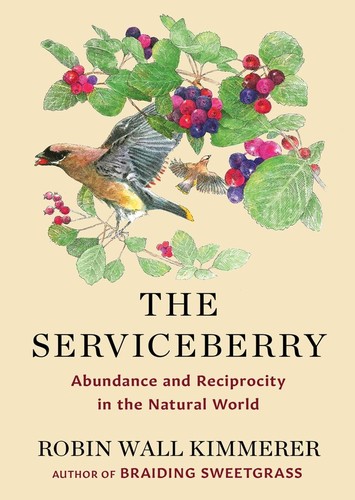
From the #1 New York Times bestselling author of Braiding Sweetgrass, a bold and inspiring vision for how to orient our lives around gratitude, reciprocity, and community, based on the lessons of the natural world.
As Indigenous scientist and author of Braiding Sweetgrass Robin Wall Kimmerer harvests serviceberries alongside the birds,…
she considers the ethic of reciprocity that lies at the heart of the gift economy. How, she asks, can we learn from Indigenous wisdom and the plant world to reimagine what we value most? Our economy is rooted in scarcity, competition, and the hoarding of resources, and we have surrendered our values to a system that actively harms what we love. Meanwhile, the serviceberry’s relationship with the natural world is an embodiment of reciprocity, interconnectedness, and gratitude. The tree distributes its wealth—its abundance of sweet, juicy berries—to meet the needs of its natural community. And this distribution insures its own survival. As Kimmerer explains, “Serviceberries show us another model, one based upon reciprocity, where wealth comes from the quality of your relationships, not from the illusion of self-sufficiency.” As Elizabeth Gilbert writes, Robin Wall Kimmerer is “a great teacher, and her words are a hymn of love to the world.” The Serviceberry is an antidote to the broken relationships and misguided goals of our times, and a reminder that “hoarding won’t save us, all flourishing is mutual.”
Others about the same length

112 pages · 4.09★ on Hardcover

130 pages · 4.26★ on Hardcover
134 pages · 3.96★ on Hardcover